

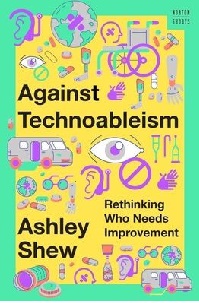
Against Technoableism - Rethinking Who Needs Improvement
by Ashley Shew
Description
When bioethicist and Professor Ashley Shew became a self-described “hard-of-hearing chemo-brained amputee with Crohn’s disease and tinnitus,” there was no returning to “normal.” Suddenly, well-meaning people called her an “inspiration” while grocery shopping or viewed her as a needy recipient of technological wizardry. Most disabled people don’t want what the abled assume they want—nor are they generally asked. Almost everyone will experience disability at some point in their lives, yet the abled persistently frame disability as an individual’s problem rather than a social one.
In a warm, feisty voice and vibrant prose, Shew shows how we can create better narratives and more accessible futures by drawing from the insights of the cross-disability community. To forge a more equitable world, Shew argues that we must eliminate “technoableism”—the harmful belief that technology is a “solution” for disability; that the disabled simply await being “fixed” by technological wizardry; that making society more accessible and equitable is somehow a lesser priority.
This badly needed introduction to disability expertise considers mobility devices, medical infrastructure, neurodivergence, and the crucial relationship between disability and race. The future, Shew points out, is surely disabled—whether through changing climate, new diseases, or even through space travel. It’s time we looked closely at how we all think about disability technologies and learn to envision disabilities not as liabilities, but as skill sets enabling all of us to navigate a challenging world.
About the Author
Ashley Shew is an associate professor of Science, Technology, and Society at Virginia Tech. Her current research sits at the intersection of technology studies, biotech ethics, and disability studies. She is a recipient of an NSF CAREER Award for work on disability narrative about technology, and a principal investigator of an Andrew W. Mellon Foundation-funded higher learning project that supports the creation of a regional Disability Community Technology (DisCoTec) Center providing guidance for developing disabled-led technology and disability-forward technological futures through humanities-based scholarship and disability justice education, arts, and outreach. Shew is the author of Against Technoableism: Rethinking Who Needs Improvement (2023) and a forthcoming open textbook, co-edited with Hanna Herdegen, Technology and Disability. Both books focus on the stories disabled people tell about technologies that people do not always expect.
Ashley’s past work has been in ethics of technology with particular interest in technological knowledge, animal studies, and emerging technologies. She is a past co-editor-in-chief of Techné, the journal of the Society for Philosophy and Technology. She is sole author of Technological Knowledge and Animal Constructions (2017) and co-editor of three philosophy of technology volumes: Spaces for the Future (with Joe Pitt, 2017), Feedback Loops (with Andrew Garnar, 2020), and Reimagining Philosophy and Technology, Reinventing Ihde (with Glen Miller, 2020).
Shew believes in cross-disciplinary, cross-disability, and public-facing scholarship: she has written for IEEE Technology & Society, Nursing Clio, Nature, the Chronicle of Higher Education, and Inside Higher Ed. She is a grateful participant with her local disability advocacy and activist communities.
Suggested resources to acquire the book: [imbed the links]